The Gamified Economy of Pocket Option
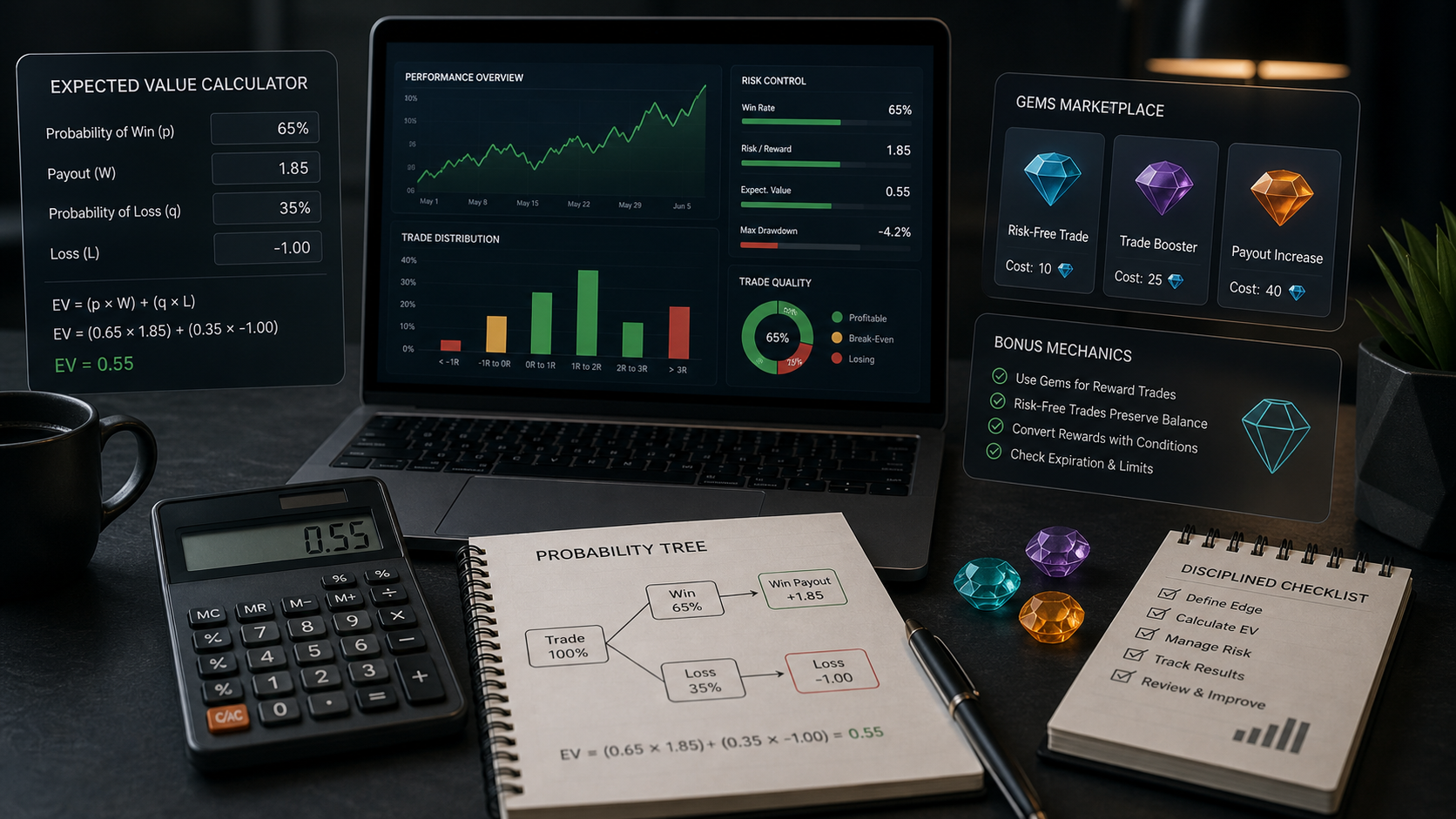
In the highly competitive environment of online retail brokerage, client retention programs have transitioned from simple, flat deposit matches to highly complex, gamified loyalty ecosystems. Pocket Option has been a pioneer in this space, introducing a virtual internal economy centered around its proprietary Gems Market. In this ecosystem, traders earn virtual currencies—namely Gems (Red, Blue, Green, and Gold)—through active trading and platform achievements. These gems can then be spent in the Market to purchase valuable operational advantages, including Cashback rebates, balance Boosters, and the highly coveted Risk-Free Trades.
However, the vast majority of retail traders treat the Gems Market as a casual novelty, spending their assets impulsively on decorative profile frames or low-value items. This represents a massive financial mistake. When analyzed through the lens of quantitative economics and probability theory, the Gems Market is a highly structured utility that can be systematically exploited to expand your statistical edge and protect your capital. This comprehensive guide provides a rigorous mathematical breakdown of the Pocket Option Market, analyzes the Expected Value (EV) of buying Chests, and demonstrates how to deploy Risk-Free Trades as professional hedging shields.
⚠️ HIGH-RISK INVESTMENT WARNING:
Trading short-term digital contracts (binary options) involves a high level of speculation and risk. A significant majority of retail investor accounts lose capital when trading these instruments. You should never invest money that you cannot afford to lose. This review is for educational purposes only and does not constitute financial advice.
Understanding the Broker's Business Model: Gamification and B-Book Counterparty Interests
To evaluate the Gems Market objectively, traders must understand the underlying operational model of the hosting broker. Pocket Option operates primarily as a "Market Maker" (B-Book broker). In a pure B-Book model, the platform does not route retail trades to external clearinghouses or liquidity providers; instead, the broker acts as the direct counterparty to every transaction. When a trader loses a position, the broker retains the entire stake as corporate revenue. When a trader wins, the payout is funded directly from the broker's reserves.
This market-making structure creates a structural conflict of interest. From a behavioral finance perspective, gamification features such as "gem mining," chest lotteries, and social achievements are sophisticated psychological tools. They are designed to create an "illusion of control" and mitigate "loss aversion bias"—the psychological discomfort of losing capital. By transforming financial transactions into game-like interactions, platforms encourage higher trading frequencies and larger capital deposits. Top-tier sovereign regulators, including the UK's Financial Conduct Authority (FCA), the European Securities and Markets Authority (ESMA), and the Australian Securities and Investments Commission (ASIC), have heavily restricted or banned retail binary options and gamified promotional systems due to high retail loss rates. Traders must evaluate the Gems Market with mathematical objectivity rather than gamified emotionalism.
The Anatomy of the Pocket Option Gem Economy
The virtual economy of Pocket Option is powered by four distinct tiers of virtual Gems: Red, Blue, Green, and Gold. These gems represent varying degrees of rarity, generation difficulty, and purchasing power. To optimize your loyalty returns, you must understand the exact mechanisms through which these assets are generated and valued.
Gem Rarity and Generation Methods
Gems are generated and distributed across your profile ledger through three primary operational paths:
- Organic Trading Volume (The Drop): As you execute trades on a live account, the platform's risk engine dynamically drops gems based on your cumulative daily turnover, transaction frequency, and win rate. Red and Blue gems are highly common and drop frequently; Green and Gold gems are rare and require massive volume or VIP status.
- Social Achievements & Milestones: Reaching specific levels in the social hierarchy, executing long consecutive winning streaks, copying master traders, or participating in daily community tournaments drops chest vouchers and raw gems.
- Gems Exchange & Social Network: Pocket Option features an internal marketplace where traders can exchange different gem types with other users through the community chat. This allows you to trade common Red gems for rare Gold gems to fund a premium purchase.
The table below provides a comparative analysis of the four gem types, mapping their relative rarity, generation difficulty, and strategic value:
| Gem Color | Rarity Tier | Generation Velocity | Relative Valuation | Optimal Strategic Use |
|---|---|---|---|---|
| Red Gem | Common | High (Drops on standard volume) | Base (1.0x) | Accumulating for basic Wooden Chest purchases |
| Blue Gem | Uncommon | Moderate (Drops on milestones) | Moderate (2.5x) | Exchanging for low-tier ($5 - $10) Risk-Free Trades |
| Green Gem | Rare | Low (Requires high-volume sessions) | High (6.0x) | Saving for premium Cashback and balance Boosters |
| Gold Gem | Ultra-Rare | Extreme (Requires VIP/Legendary chests) | Extreme (15.0x) | Redeeming elite $100+ Risk-Free Trades |
Chest Economics: Analyzing Expected Value (EV) and ROI
Chests represent the primary lottery mechanism in the Pocket Option Market. Traders can spend their accumulated common gems (primarily Red and Blue) to purchase various tiers of Chests, which contain a randomized assortment of rare gems, promo codes, and active trading tools. To determine whether buying a chest is a mathematically sound decision, we must apply the Expected Value (EV) formula.
The Expected Value Equation
Let $P(I_i)$ represent the probability of winning item $i$ from a specific chest, and $V(I_i)$ represent the market valuation of that item in baseline gem units. The Expected Value of a chest is calculated as:
If the purchase price of the chest (expressed in baseline gem units) is less than the EV ($\text{EV} > \text{Cost}$), the transaction represents a positive mathematical expectation, making it profitable in the long run. If the cost is higher than the EV, the purchase is a negative expectation lottery and should be avoided, with gems saved for direct item redemptions instead.
Comparison of Chest Tiers:
- Wooden Chest (Cost: Low): Drops primarily Red and Blue gems, with a very stable but low-yielding EV. It has a high probability (~80%) of returning its exact cost in basic gems, making it a safe, low-risk way for beginners to consolidate assets.
- Iron Chest (Cost: Medium): Introduces a moderate drop rate (~10%) for low-value promo codes and a very small probability (~5%) of dropping active $5 Risk-Free Trades. The EV is slightly positive but highly volatile.
- Golden/Legendary Chest (Cost: Extreme): Features a high probability of dropping rare Green and Gold gems, along with premium balance Boosters (+50% matches) and high-value Risk-Free Trades ($50 to $100 value). While the cost is extremely high, the EV is heavily positive, offering the highest long-term return on investment (ROI) for high-volume traders who need rare assets to fund premium redemptions.
Risk-Free Trades: The Ultimate Capital Hedging Strategy
The single most valuable operational tool available in the Pocket Option Market is the Risk-Free Trade (RFT). This coupon acts as a direct, retroactive insurance policy on a single transaction. If the trade wins, you keep the profits; if it loses, you activate the RFT, and the broker credits the full lost stake back to your live account balance instantly.
The Asymmetric Payoff Math
In quantitative trading, a standard, uninsured trade carries a symmetric risk profile: you either win and capture the payout, or you lose and forfeit your entire stake. By introducing a Risk-Free Trade coupon, you truncate the negative side of the probability distribution. The downside is capped at zero, while the upside remains fully intact. Let us compare the payoff matrices mathematically:
- Standard $100 Trade (85% Payout):
$$\text{Win Payout: } +\$85 \quad | \quad \text{Loss Payoff: } -\$100$$
$$\text{Standard EV: } (p \times \$85) - (q \times \$100)$$ - $100 Risk-Free Trade (85% Payout):
$$\text{Win Payout: } +\$85 \quad | \quad \text{Loss Payoff: } \$0 \text{ (Balance Restored)}$$
$$\text{Risk-Free EV: } (p \times \$85) + (q \times \$0) = p \times \$85$$
Because the downside risk is eliminated ($q = 0$), the Expected Value of an RFT position is always strictly positive, regardless of your historical win rate. Even a trader with a 30% win rate will generate a positive mathematical return when deploying this tool.
The Optimal Deployment Blueprint
To extract the absolute maximum value from a Risk-Free Trade voucher, you must not deploy it randomly. Follow this professional hedging blueprint:
- Deploy ONLY on High-Payout Assets: Payout percentages on Pocket Option fluctuate between 50% and 92% depending on the asset and time of day. Because the win payout directly dictates your positive EV ($p \times \text{Payout}$), you must execute your RFT position only when the asset payout is at its maximum (typically 85% to 92% on major currency pairs).
- Deploy During High-Impact Economic News: High-frequency traders avoid executing positions during major economic releases (like NFP, CPI, or central bank interest rate decisions) due to extreme volatility and price expansion. This volatility is the perfect environment for an RFT. The extreme price expansion increases the probability of a massive payout, while the RFT shield completely neutralizes the risk of a whip-saw loss.
- Scale Your Position Size: If you possess a $100 RFT voucher, execute a position size of exactly $100. Risking less than the voucher value (e.g., executing a $50 trade with a $100 voucher) wastes 50% of the insurance capacity, reducing your net ROI.
Operational Best Practices: Maximizing Your Loyalty Yield
To systematically extract maximum economic value from the Pocket Option virtual economy, you must treat your gem balance as an investment portfolio. Strictly adhere to these operational best practices:
- Never Spend Gems on Cosmetic Items: The Market offers various cosmetic perks, such as custom profile avatars, social chat badges, and decorative terminal frames. These items carry zero economic value and represent a complete waste of purchasing power. Save your gems exclusively for functional financial assets.
- Prioritize Risk-Free Trades Over Cashback: While Cashback vouchers (e.g., 10% monthly rebate on net losses) are attractive, they require you to generate losses and sustain high trading volumes to clear. Risk-Free Trades, conversely, provide an immediate 100% capital recovery on a specific losing position, offering a significantly higher and faster mathematical return on your gem investment.
- Time Your Boosters: Balance Boosters (e.g., +10% deposit matches that do not lock your principal deposit) should be purchased and activated only when you are preparing to execute a major capital deposit, maximizing the matched capital cushion.
- Leverage the Social Exchange: If you are just a few Gold gems short of purchasing a premium $100 Risk-Free Trade, do not buy low-value items. Use the community chat to trade your excess Red and Blue gems with other traders to acquire the specific Gold gems you need.
🔥 EXCLUSIVE OFFER: POCKET OPTION GEM ACCELERATOR PROMO
Register your trading account using the promo code BRGEMBOOST to instantly activate a 2x Gem Accelerator. This loyalty multiplier doubles your organic gem drop rates for 30 days, allowing you to redeem high-value Risk-Free Trades rapidly.
*Wagering Disclaimer: Risk-free trades are credited as profile vouchers. Activating a voucher fully restores a losing trade's stake up to the voucher's face value. All speculative trading carries high capital risk.
Frequently Asked Questions (FAQ)
Q1: Do my accumulated gems expire if my account becomes inactive?
No. Pocket Option gems are stored securely on your profile's permanent ledger and do not expire. Even if you take a break from trading and your account becomes temporarily inactive, your gem balance remains fully intact, ready to be spent whenever you log back into the Market.
Q2: Can I withdraw my gem balance directly as cash?
No. Gems are strictly an internal, non-monetary loyalty token. They have no sovereign currency value and cannot be withdrawn directly as cash. They must be spent in the platform's Market to purchase tradeable assets like Risk-Free Trades, which can then be converted into real, withdrawable profits through active trading.
Q3: Is there a limit to how many Risk-Free Trades I can use in a month?
No. Pocket Option does not impose any limit on the number of Risk-Free Trades you can redeem, provided you have the required gem balance in your profile to purchase them from the Market. High-volume traders who accumulate thousands of gems can systematically use RFTs as a core part of their daily risk-hedging strategy.
Q4: What is the maximum value of a single Risk-Free Trade available in the Market?
The standard Market catalog offers Risk-Free Trade vouchers ranging from $5 up to $1,000. The premium $1,000 Risk-Free Trade requires a significant accumulation of rare Gold and Green gems, representing the ultimate milestone award for VIP loyalty tier members.
Q5: Can I use a Risk-Free Trade on a position that was executed on a demo account?
No. Risk-Free Trades are designed exclusively for live, real-money trading accounts. Since demo trades are executed using simulated paper money and carry no real financial risk, they do not generate losses that can or need to be recovered via the Risk-Free Trade mechanism.