The Search for the "Best" Strategy: Reality vs. Retail Illusion
In the retail trading ecosystem, the search for the "best" strategy is often driven by a fundamental misconception: that a specific combination of technical indicators can guarantee profit. This illusion is particularly prevalent on short-term digital options platforms like Quotex, where the simplicity of "higher or lower" contract execution masks a highly complex, mathematically challenging environment. Promoters and affiliate networks frequently market "sure shot" or "99% win rate" indicator setups. In reality, no indicator can predict future price action with certainty, and the primary driver of long-term trading outcomes is not the strategy itself, but disciplined risk management and mathematical break-even awareness.
This guide provides an objective, quantitative deconstruction of binary options trading strategies on Quotex for 2026. We analyze the mathematical realities of the platform's payout structures, outline a professional trend-and-momentum confluence strategy, and audit the counterparty and regulatory risks that retail traders must navigate before committing real capital.
⚠️ HIGH-RISK INVESTMENT WARNING:
Trading digital contracts involves a high level of risk and can result in the complete loss of your deposited capital. A significant majority of retail investor accounts lose money when trading these instruments. You should never invest funds that you cannot afford to lose. This article is strictly for educational and informational purposes and does not constitute financial, legal, or investment advice.
The Mathematics of Digital Contracts: The Break-Even Hurdle
Before executing any strategy on Quotex, a trader must understand the mathematical payoff structure of a digital contract. Unlike traditional asset classes where profits and losses are symmetrical, binary options have an asymmetrical payout. On Quotex, a winning trade typically pays out between 70% and 90% of the initial stake, while a losing trade results in a 100% loss of the stake.
To break even over a series of trades, your win rate must satisfy the following formula:
Break-Even Win Rate = 1 / (1 + Payout Rate)
Depending on the average payout rate offered by the platform for a given asset and time frame, the required break-even win rates vary significantly:
| Average Payout Rate | Required Win Rate to Break Even | Margin of Error Allowed |
|---|---|---|
| 90% | 52.63% | Trader must win ~5.3 out of 10 trades |
| 80% | 55.56% | Trader must win ~5.6 out of 10 trades |
| 70% | 58.82% | Trader must win ~5.9 out of 10 trades |
| 60% | 62.50% | Trader must win ~6.3 out of 10 trades |
This mathematical asymmetry means that even if a trader maintains a 50% win rate—which is typical for random selection—their account balance will steadily decline. Factors such as platform execution latency, slippage, and fluctuating payout rates can further degrade performance. Consequently, any viable strategy must demonstrate a consistent, verified edge that generates a win rate well above 55%. If you want to compare how these payouts behave compared to other brokers, see our Quotex vs Pocket Option comparison.
Trend-Following Core: Moving Average Confluence
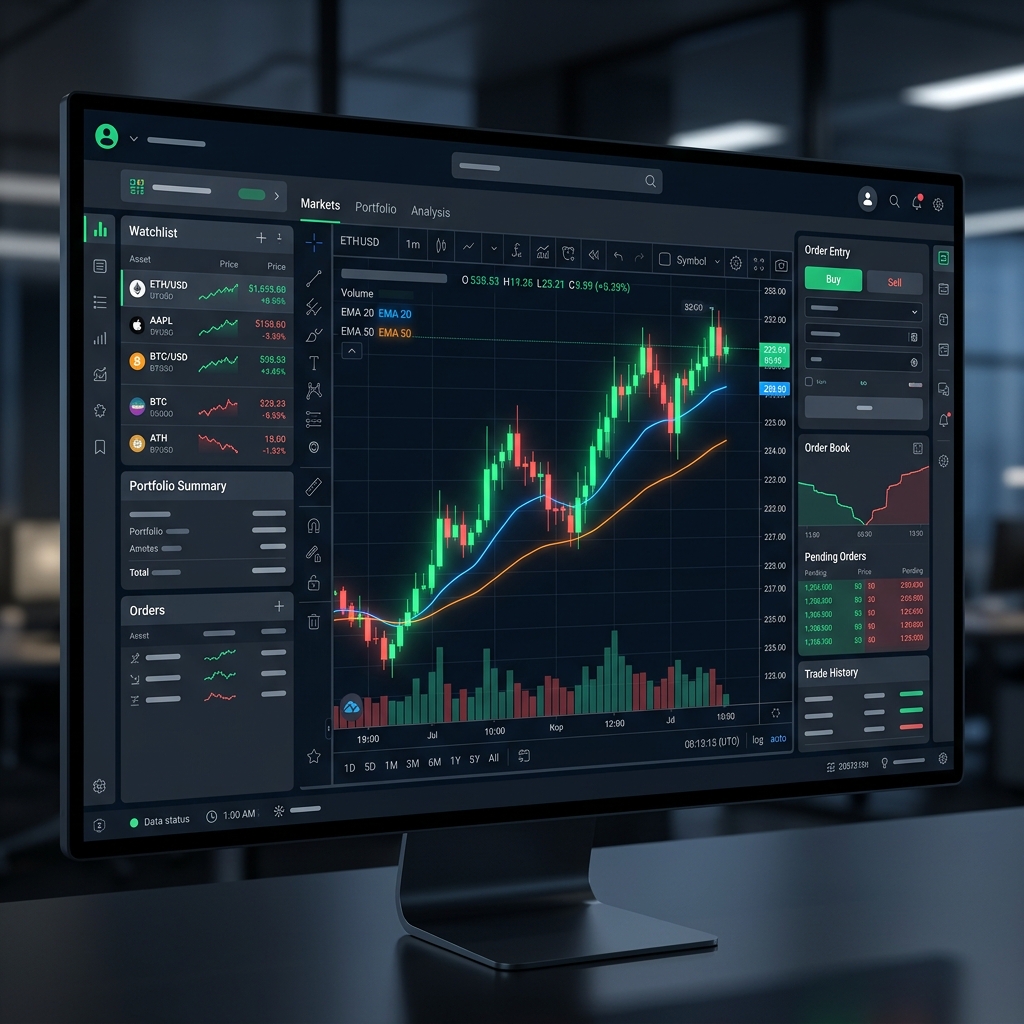
To establish a statistical edge, traders often begin by identifying the macro-trend. Trading in the direction of the prevailing trend reduces the likelihood of entering trades against strong market momentum. A standard trend-following setup for Quotex in 2026 utilizes two distinct Exponential Moving Averages (EMAs):
- EMA 20 (Fast Line): Responds quickly to recent price changes, indicating short-term momentum.
- EMA 50 (Slow Line): Filters out minor price volatility, indicating medium-term trend direction.
- EMA 200 (Baseline): The long-term trend filter. If price is above the EMA 200, only buy ("Call") signals are considered; if below, only sell ("Put") signals.
1. Open the Indicators menu in the bottom-left corner of the Quotex chart.
2. Add three Moving Average indicators.
3. Configure the first to Period: 20 (Type: EMA, Color: Green).
4. Configure the second to Period: 50 (Type: EMA, Color: Orange).
5. Configure the third to Period: 200 (Type: EMA, Color: Blue).
A basic trend entry signal occurs when the EMA 20 crosses the EMA 50 in the direction of the EMA 200. For example, a bullish crossover occurs when the EMA 20 crosses above the EMA 50 while the price action remains entirely above the EMA 200. However, using moving average crossovers in isolation often results in false breakouts during flat or ranging markets. To filter out these false signals, traders must use momentum oscillators as a secondary confirmation gate.
Momentum Filter: RSI and CCI Confluence
To avoid entering a trend-following trade when the market is already overextended (and thus prone to a sudden reversal), professional strategies integrate momentum oscillators. For 2026, the confluence of the Relative Strength Index (RSI) and the Commodity Channel Index (CCI) is a common configuration:
- RSI (14): Measures the speed and change of price movements. Standard thresholds are set at 70 (overbought) and 30 (oversold). If the RSI is above 70, entering a "Call" contract is high-risk, even in a strong uptrend, as a pullback is likely.
- CCI (14): Measures the current price level relative to an average price level over a given period. It fluctuates between +100 and -100. A breakout above +100 indicates strong bullish momentum, while a drop below -100 indicates strong bearish momentum.
The concept of Confluence dictates that a trade is only executed when all technical indicators align. The table below outlines the precise criteria required for a high-probability trade entry:
| Indicator Segment | Bullish Setup (Call Contract) | Bearish Setup (Put Contract) |
|---|---|---|
| Price vs. EMA 200 | Price must be trading above the EMA 200 | Price must be trading below the EMA 200 |
| EMA Crossover | EMA 20 has crossed above the EMA 50 | EMA 20 has crossed below the EMA 50 |
| RSI (14) Filter | RSI is between 50 and 70 (not overbought) | RSI is between 30 and 50 (not oversold) |
| CCI (14) Confirmation | CCI has recently crossed above the +100 line | CCI has recently crossed below the -100 line |
By enforcing this strict confluence filter, traders ensure they are only participating in moves where both structural trend direction (EMA) and immediate momentum breakout (CCI) agree, while avoiding overextended conditions (RSI). For a detailed walkthrough of short-term configurations, see our guide on the Quotex 1-minute trading strategy.
Risk Management: The 1–2% Capital Rule
Even the most advanced confluence strategy will experience consecutive losses due to market noise, unexpected economic news releases, or platform slippage. If a trader risks a large portion of their account balance on each trade, a short series of losses will result in account liquidation. Therefore, strict risk management is mandatory.
- Maximum Position Sizing: Never risk more than 1% to 2% of your total account balance on a single trade. If your account balance is $1,000, your maximum trade size must be $10 to $20.
- Banish the Martingale Strategy: Many binary options affiliates recommend the Martingale system (doubling your stake after a loss to recover losses). In a market with an asymmetrical payout structure, Martingale is mathematically guaranteed to lead to catastrophic account loss during a standard drawdown streak. A sequence of just six consecutive losses on a $10 initial trade requires a $640 seventh trade, exposing the trader's entire capital to a single contract.
- Session Limits: Set a daily stop-loss limit (e.g., losing 5% of your total account balance) and a daily take-profit target (e.g., gaining 10%). Once either limit is reached, stop trading immediately. This prevents emotional "revenge trading" or greed-driven overtrading.
Broker Counterparty & Regulatory Risk Audit
When trading digital options, your strategy is only as safe as the platform hosting your funds. Because binary options transactions do not settle on an open exchange, you are entirely dependent on the financial integrity and business practices of the broker. Traders must maintain an objective awareness of the risks associated with Quotex:
- Lack of Tier-1 Regulation: Quotex is a brand name operated by Maxbit LLC, which is registered in Saint Vincent and the Grenadines. It is not licensed by reputable financial regulators like the UK's FCA, Australia's ASIC, or Cyprus's CySEC. This lack of oversight means there is no government-backed investor compensation scheme if the broker goes bankrupt.
- Regulatory Warnings: Multiple national financial regulators, including BAPPEBTI (Indonesia), CMVM (Portugal), and the Securities Commission Malaysia (SCM), have blacklisted the broker or issued public warnings against the platform for offering unauthorized financial services. Check our Quotex regulatory status report for country-specific analysis.
- KYC and Withdrawal Bottlenecks: To access your profits, you must complete the Know Your Customer (KYC) verification process. This requires uploading government-issued identification and proof of address. According to platform terms, Quotex reserves the right to request additional verification documentation or audit your account history if suspicious trading patterns are detected. For a mathematical breakdown of payment lifecycles, see the Quotex withdrawal proof audit. If you want details on deposit rules, read the deposit and withdrawal guide.
Conclusion: The Demo Account Validation Protocol
No strategy should ever be deployed with real capital without extensive testing. The most reliable way to validate the EMA and RSI/CCI confluence strategy is by utilizing the Quotex demo account, which provides virtual funds under real-time market data conditions.
A professional validation protocol requires executing at least 100 historical and real-time paper trades. Record the payout rate, the exact entry time, the indicator values, and the trade outcome in a spreadsheet. Calculate your average win rate. Only if your demo win rate consistently exceeds the break-even hurdle (55%–60%) over a representative sample of market conditions should you consider transitioning to micro-lot live trading. Always remember that digital options are highly speculative instruments, and capital preservation must remain your primary objective.